


14 July 2026
No Comments
iHuman assignment
ihuman margaret wilson shortness of breath heart failure 60 year old answers
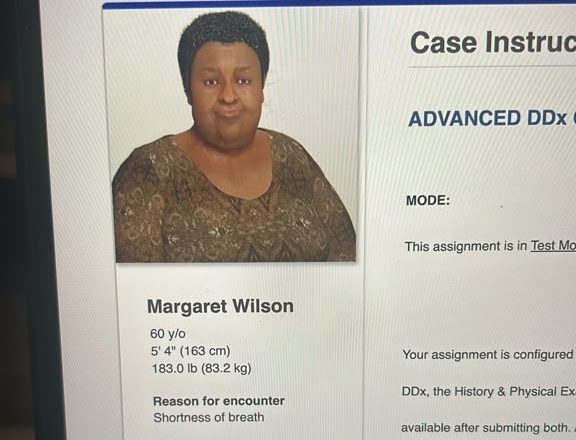
60 y/o
5′ 4″ (163 cm)
183.0 lb (83.2 kg)
Reason for encounter
Shortness of breath
iHuman Margaret Wilson shortness of breath heart failure answers history questions
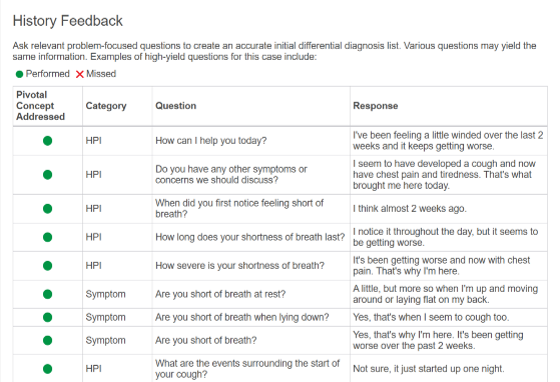
- How can I help you today?
- Do you have any other symptoms or concerns we should discuss?
- Have you been having fevers?
- Do you have night sweats?
- Do you wheeze?
- Are you short of breath?
- When did you first notice feeling short of breath?
- How long does your shortness of breath last?
- What are the events surrounding the start of your shortness of breath?
- Does your shortness of breath come and go?
- Does anything make your shortness of breath better or worse?
- Are you short of breath when lying down?
- Are you short of breath at rest?
- How severe is your shortness of breath?
- Do you awaken at night short of breath?
- What treatments have you tried for your shortness of breath?
- Are you………
Margaret Wilson shortness of breath 60 year old ihuman physical exams required
- Weight
- Height
- cognitive status
- SpO2
- temperature
- blood pressure
- pulse
- respiration
- temperature
- auscultate heart
- auscultate lungs
- assess …….
iHuman Margaret Wilson Case Study: Clinical Approach to a 60-Year-Old with Shortness of Breath
Mastering clinical simulation platforms like iHuman requires a systematic approach to patient assessment, diagnostic reasoning, and care planning. One of the most frequently encountered scenarios in advanced practice nursing and medical programs is the clinical case of Margaret Wilson, a 60-year-old female presenting with a primary complaint of progressive shortness of breath.
Navigating this case successfully involves asking the right history questions, performing a targeted physical examination, formulating an accurate differential diagnosis, and designing an evidence-based management plan.
This comprehensive case overview outlines the clinical pathway for Margaret Wilson, helping students understand the core physiological concepts and maximize their simulation performance. For step-by-step guidance, expert rationales, and structured walkthroughs, you can access the Margaret Wilson iHuman Case Answers and Study Guide on iHuman Tutor.
Patient Profile & Clinical Scenario
Understanding the patient’s baseline is the first step in clinical reasoning. The scenario presents a standard outpatient encounter that rapidly demands clinical triage:
Name: Margaret Wilson (M.W.)
Age/Gender: 60-year-old female
Chief Complaint: Progressively worsening shortness of breath over a two-week period.
Co-existing Symptoms: Dry, non-productive cough (worse when lying flat), central chest tightness/pain for three days, recent onset of fatigue, and rapid, unexplained weight gain.
Significant Past Medical History (PMH): Coronary Artery Disease (CAD), hypertension (HTN), and hyperlipidemia.
Navigating the iHuman History Questions
The history questions segment is crucial for scoring well on the iHuman platform. For Margaret Wilson, your inquiry must pivot around her cardiopulmonary system to identify key triggers and relieving factors.
Key Areas to Explore:
Symptom Chronology: Focus on the timeline of her dyspnea (2 weeks) versus her chest pain and fatigue (3 days).
Positional Changes (Orthopnea): Inquire about how lying flat affects her breathing and her dry cough. Positional worsening is a major hallmark of volume overload.
Fluid Retention: Ask targeted questions regarding sudden weight changes (she noted an 8-pound weight gain in 2 weeks) and peripheral changes, such as tight-fitting socks or ankle swelling.
Social History & Risk Factors: Document her 20-pack-year tobacco history and moderate-to-heavy alcohol intake, which significantly elevate her cardiovascular risk profile.
Targeted Physical Examination
During the physical examination portion of the iHuman simulation, students must systematically document objective, measurable findings. For a 60-year-old presenting with cardiorespiratory distress, focus your exam on fluid status and cardiac efficiency.
Formulating the Differential Diagnosis
In iHuman, you are required to organize and rank a list of potential diagnoses. When a patient presents with shortness of breath, chest pain, and fluid retention in the setting of chronic CAD, your differential diagnosis list must address both primary cardiac causes and secondary pulmonary or systemic conditions.
Primary Classifications to Consider:
Acute Decompensated Heart Failure (ADHF): Strongly suggested by the combination of orthopnea, nocturnal dry cough, rapid weight gain.
Acute Coronary Syndrome (ACS) / Myocardial Ischemia: Must remain high on your differential due to her active, dull central chest pain and extensive history of CAD and smoking.
Pneumonia or Acute Bronchitis: Though less likely due to the absence of fever, chills, or productive sputum, it remains a common cause of acute dyspnea and cough.
Pulmonary Embolism (PE): A critical rule-out for any patient presenting with acute-on-chronic shortness of breath and chest discomfort.
Designing the Management Plan
The final stage of the simulation is developing an appropriate management plan. Because M.W. exhibits signs of active fluid volume overload and cardiac chest pain, the primary management priority is rapid stabilization and safe triage.
[In-Clinic Evaluation: STAT ECG & CXR]
                 │
                 ▼
[Urgent Emergency Department Transfer via EMS]
                 │
                 ▼
[Inpatient Stabilization: IV Diurectics & Cardiac Workup]
                 │
                 ▼
[Post-Discharge Follow-Up & Lifestyle Education]
Immediate Diagnostics: Order a STAT 12-lead ECG and a chest X-ray in the clinic to rule out an acute myocardial infarction and confirm pulmonary congestion. Avoid delay by deferring non-urgent lab draws to the emergency room.
For a deeper dive into the specific grading rubrics, diagnostic test selections, and sample documentation templates for this clinical scenario, visit iHuman Tutor and explore the comprehensive Margaret Wilson Case Answers.