



2 September 2026
No Comments
iHuman assignment
iHuman Chester Wilson acute left knee pain for 2 days answers
Chester Wilson
57 y/o
5′ 10″ (178 cm)
197.0 lb (89.5 kg)
Reason for encounter
Acute left knee pain for 2 days
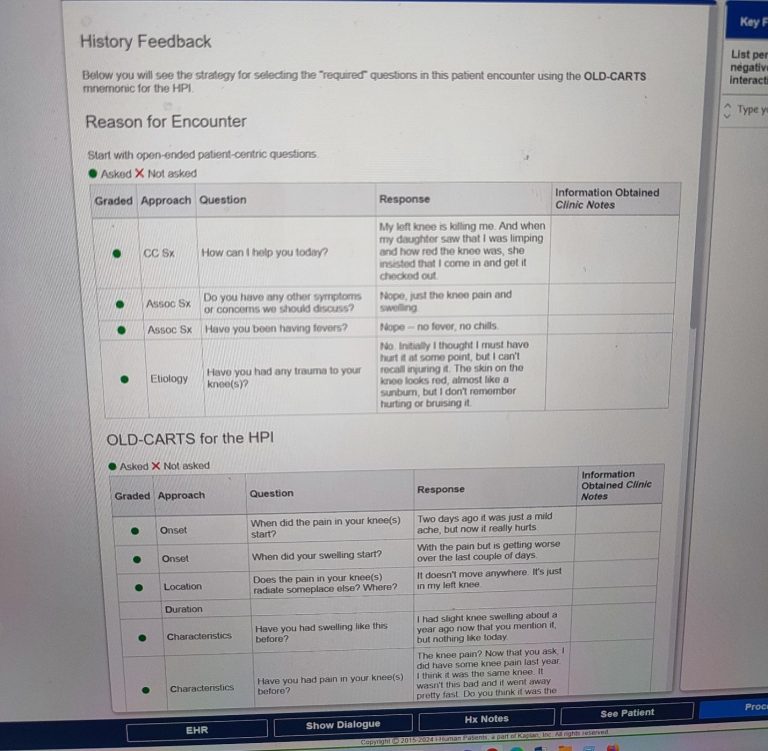
iHuman Chester Wilson acute left knee pain for 2 days History Questions
- How can I help you today?
- Do you have any other symptoms or concerns we should discuss?
- How does this affect your life?
- Have you been having fevers?
- Have you had any trauma to your knee(s)?
- Is there any instability in your knee(s)?
- Do you have any pain in your knee(s)?
- Do your knees catch, lock, or pop?
- What are the events surrounding the start of the pain in your knee(s)?
- Does anything make the pain in your knee(s) better or worse?
- Have you had any trauma to your knee(s)
- Have you had any swelling like this before
- Have you had pain in your knee(s) before…….
iHuman Chester Wilson acute left knee pain for 2 days answers
Physical Exams Required
- Weight
- Height
- cognitive status
- SpO2
- temperature
- blood pressure
- pulse
- respiration
- temperature
- auscultate heart
- auscultate lungs
- assess …….
iHuman Chester Wilson Case Study: Acute Left Knee Pain for 2 Days
The iHuman Chester Wilson case presents an important clinical reasoning challenge involving a 57-year-old patient with acute left knee pain for 2 days. At first glance, the presentation may appear to represent a straightforward musculoskeletal complaint. However, the combination of acute pain, swelling, erythema, impaired mobility, and additional clinical clues requires a careful and systematic approach.
This case is particularly useful for students learning how to connect history questions, physical examination, diagnostic reasoning, differential diagnosis, and the development of an appropriate management plan.
Chester Wilson iHuman Case Overview
Chester Wilson is a 57-year-old male who seeks medical evaluation because of significant pain involving his left knee. The symptoms have developed over a short period and have progressively interfered with his ability to walk and perform his usual activities.
The patient’s presentation provides several important clinical clues. The onset is not associated with a clearly recalled injury, and the symptoms involve a single joint. His history also includes previous joint symptoms and several factors that may be relevant when considering inflammatory joint conditions.
For students completing the iHuman Chester Wilson simulation, recognizing these relationships is more important than simply identifying an isolated symptom.
Acute Left Knee Pain for 2 Days
The central complaint in this case is acute left knee pain for 2 days. The patient’s description provides information about onset, progression, location, quality, severity, aggravating factors, relieving factors, and functional limitations.
The pain progressed from a relatively mild sensation to substantially more severe discomfort. Activity, particularly movement and weight-bearing, has become difficult. The patient has consequently reduced his normal physical activity.
This pattern makes a carefully constructed history particularly important. Acute monoarticular presentations can have multiple causes, and distinguishing among them requires integration of subjective and objective information rather than relying on pain severity alone. (AAFP)
Why the History Questions Matter
The history questions in the iHuman simulation are designed to uncover clinically meaningful information. Students should approach the interview systematically and consider questions addressing:
Timing and progression of symptoms
Previous episodes
Trauma or mechanical injury
Characteristics and severity of pain
Functional impairment
Other affected joints
Constitutional symptoms
Current prescription and OTC medications
Relevant medical history
Alcohol and tobacco exposure
Dietary patterns
Family history
Previous procedures and hospitalizations
Several responses in this case become particularly important when considered together. The medication history, previous episode, lifestyle factors, and findings involving another joint all provide context for the clinical reasoning process.
Physical Examination: What Should Students Recognize?
The physical examination is another major component of the Chester Wilson case. The affected knee demonstrates several findings that indicate an active inflammatory process.
The examination focuses on characteristics such as swelling, erythema, warmth, tenderness, joint effusion, range of motion, strength, gait, and stability. The comparison with the opposite knee is also important.
The patient’s ability to move and bear weight is substantially affected. Reduced active and passive range of motion can help indicate an intra-articular process. In acute monoarthritis, comparing active and passive movement with the unaffected joint is an important part of the assessment. (AAFP)
An additional finding involving the foot provides another important diagnostic clue. This illustrates why examination should not stop at the painful joint; adjacent joints and the remainder of the musculoskeletal system may provide information that changes the diagnostic picture.
Understanding the Differential Diagnosis
The differential diagnosis for acute monoarticular knee pain is broad. Potential considerations include inflammatory, infectious, degenerative, traumatic, and crystal-associated disorders.
The clinical challenge is determining which possibilities are supported by the patient’s overall presentation and which are less likely.
Important considerations in an acutely swollen, warm, erythematous joint include infectious arthritis and crystal-associated arthritis. Degenerative disease and internal derangement may also enter the differential depending on the history and examination. Septic arthritis deserves particular attention because delayed recognition can result in serious complications. (PubMed)
Importantly, an elevated serum urate level alone should not be treated as definitive proof of a particular diagnosis. Synovial fluid evaluation can be particularly valuable when evaluating acute monoarthritis because it can help distinguish infectious and inflammatory causes. (AAFP)
Diagnostic Reasoning and Testing
The diagnostic portion of the iHuman Chester Wilson case demonstrates why laboratory results must be interpreted in the context of the complete clinical presentation.
Inflammatory markers, blood testing, serum urate measurements, and joint-fluid evaluation may contribute different pieces of information. Each test should have a clear clinical purpose.
For example, joint aspiration and synovial fluid analysis are especially important when an acutely inflamed joint raises concern for infection or crystal-associated disease. Current clinical guidance emphasizes analysis that can include synovial white blood cell count with differential, Gram stain, culture, and crystal examination when septic arthritis is being considered. (AAFP)
This is an important lesson for students: diagnostic tests should answer clinical questions rather than simply be ordered because they are available.
Developing the Management Plan
The final portion of the case requires students to construct a comprehensive management plan based on the information gathered.
A well-developed plan should consider the patient’s immediate symptoms, potential underlying condition, existing medications, cardiovascular risk factors, lifestyle, and need for monitoring.
Management of acute inflammatory joint symptoms may involve pharmacologic and nonpharmacologic strategies, but treatment should be based on the clinical assessment and diagnostic information. Long-term management considerations may also differ from treatment of the immediate flare.
Students should pay particular attention to medications that can influence serum urate levels and to modifiable lifestyle factors. Evidence-based gout guidance recommends incorporating patient education, appropriate pharmacologic therapy, lifestyle considerations, and ongoing monitoring when gout is established. (Nice)
What Makes the Chester Wilson Case Challenging?
The iHuman Chester Wilson simulation tests more than the ability to recognize knee pain. It requires students to connect multiple pieces of information across the encounter.
The most important learning objectives include:
Obtaining a focused but comprehensive history.
Identifying clinically significant positive and negative findings.
Performing an appropriate musculoskeletal physical examination.
Recognizing findings that narrow the differential diagnosis.
Understanding the purpose of diagnostic testing.
Interpreting laboratory and synovial-fluid findings in context.
Developing a patient-specific management plan.
Connecting medication and lifestyle factors with the patient’s presentation.
Need the Comprehensive iHuman Case Answers?
The Chester Wilson case contains considerably more detail than can be appropriately summarized in a public case overview. If you are working through the 57-year-old Chester Wilson iHuman case and need help organizing the complete encounter, the comprehensive resource can provide a structured reference for the different components of the simulation.
For the complete case resource, visit:
iHuman Chester Wilson – Acute Left Knee Pain for 2 Days
You can also explore the broader iHuman Tutor resource library for additional virtual-patient cases, clinical reasoning resources, history-taking guidance, physical examination documentation, differential-diagnosis material, and management-plan support.
The goal is not simply to memorize iHuman answers, but to understand how the patient’s history, examination, diagnostic information, and clinical reasoning connect to one another. That approach can make challenging virtual patient encounters easier to understand and can strengthen the clinical reasoning skills needed beyond the simulation itself.