


6 September 2026
No Comments
iHuman assignment
iHuman Hua Zhang chest pain answers
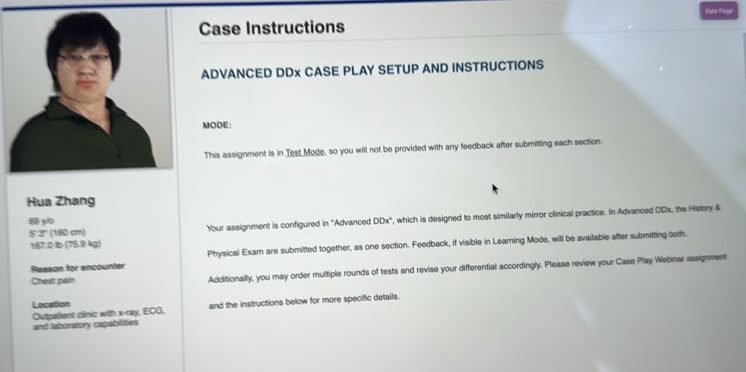
Hua Zhang
69 y/o
5’3” (160cm)
167.0 lb. (75.9 kg)
Reason for encounter – chest pain
Patient | Hua Zhang | Date of Encounter | Current visit |
Age / Sex | 69-year-old female | Reason for Encounter | Chest pain |
Height | 63 in (160 cm) | Weight | 167.0 lb (75.9 kg) |
BMI | 29.6 (overweight) | Allergies | No known drug allergies |
iHuman Hua Zhang chest pain History Questions
- How can I help you today?
- Do you have any other symptoms or concerns we should discuss?
- Does your chest feel tight or heavy?
- When did the pain in your chest start?
- What are the events surrounding the start of your chest pain?
- Does the pain in your chest come and go?
- How long does your chest pain last?
- Where more precisely is the pain in your chest?
- Does anything make the pain in your chest better or worse?
- What treatments have you had for the pain in your chest?
- Do you …….
iHuman Hua Zhang chest pain Physical Exams Required
- Weight
- Height
- cognitive status
- SpO2
- temperature
- blood pressure
- pulse
- respiration
- temperature
- auscultate heart
- auscultate lungs
- assess …….
The iHuman Hua Zhang Case Study: A 69-Year-Old Female Presenting With Chest Pain
Nursing and advanced practice students working through the iHuman simulation platform frequently encounter complex cardiovascular cases that test their ability to synthesize subjective and objective data into a coherent clinical picture. One case that continues to generate significant discussion among NP and DNP students is the Hua Zhang case: a 69-year-old female presenting with chest pain.
Overview of the iHuman Hua Zhang Case
The Hua Zhang case centers on a 69-year-old female patient whose chief complaint is chest pain. Like most iHuman virtual patient simulations, the case is designed to assess a student’s competency across several domains: history-taking, physical examination technique, clinical reasoning, differential diagnosis formulation, and the development of an evidence-based management plan.
What makes this case particularly challenging is the patient’s underlying cardiac risk profile. Students must weigh subtle historical clues against physical exam findings to arrive at a clinically sound assessment, all while avoiding common pitfalls such as premature closure or missing critical red-flag symptoms.
Why the Chest Pain Presentation Is Clinically Significant
Chest pain in an older adult female is one of the highest-stakes presentations in primary care and emergency medicine education. Unlike more straightforward complaints, chest pain requires students to consider a broad differential that spans cardiac, pulmonary, gastrointestinal, and musculoskeletal systems. The stakes are amplified in patients over 65, where atypical presentations of serious cardiac disease are more common.
For the Hua Zhang case specifically, students report that the history questions are designed to reveal a nuanced symptom pattern rather than an obvious textbook presentation. This is intentional. iHuman cases are built to mimic real clinical ambiguity, and students who rush through the interview often miss key details that shape the entire trajectory of the encounter.
The Importance of a Thorough History in This Case
A well-conducted history is the foundation of any successful iHuman encounter, and the Hua Zhang case is no exception. Students are expected to explore the OLDCARTS framework (onset, location, duration, character, aggravating factors, relieving factors, timing, and severity) while also screening for red-flag symptoms that could indicate an evolving cardiac event.
Beyond the presenting complaint, a comprehensive past medical history, medication review, family history, and social history all play a role in shaping the differential diagnosis. Many students underestimate how much these background elements influence the final assessment and plan, particularly in a patient with an established cardiovascular history.
Physical Examination Considerations
The physical examination portion of the Hua Zhang case tests a student’s ability to perform a focused, systems-based exam rather than a generic head-to-toe assessment. Cardiovascular auscultation, respiratory assessment, and targeted maneuvers to help rule in or rule out musculoskeletal causes of chest discomfort are all essential components.
Students are often surprised by how much weight examiners place on the ability to correctly interpret exam findings in the context of the history already obtained. A murmur, a vital sign abnormality, or the absence of a particular finding can dramatically shift the direction of the differential diagnosis.
Building the Differential Diagnosis
One of the most academically demanding parts of this case is constructing a differential diagnosis that reflects true clinical reasoning rather than guesswork. Given the patient’s age, sex, and risk factors, students must weigh multiple possibilities against one another, using the data gathered during history-taking and the physical exam to rank each diagnosis by likelihood.
This is often where students lose the most points. A differential diagnosis that fails to account for the patient’s complete risk profile, or that ranks diagnoses without clear supporting rationale, tends to fall short of faculty expectations.
Formulating a Management Plan
The final component of the Hua Zhang case, and arguably the most complex, is the management plan. This includes diagnostic workup recommendations, referral decisions, pharmacologic management, and patient education. A strong management plan is grounded in current evidence-based guidelines and reflects an understanding of how each intervention connects back to the working diagnosis.
Students frequently struggle to strike the right balance between thoroughness and conciseness in this section, and instructor feedback often centers on gaps in the reasoning behind specific recommendations.
Why Students Seek Support With This Case
Given the complexity of the Hua Zhang case, from the layered history to the nuanced physical exam and the demands of an evidence-based management plan, it is no surprise that many nursing and NP students look for structured support to strengthen their understanding. Working through a case like this on your own can be time-consuming, and it is easy to miss the subtle details that separate a passing grade from an exceptional one.
Get Comprehensive Answers and Support
If you are working through the Hua Zhang iHuman case and want a fully structured breakdown of the history questions, physical examination findings, differential diagnosis, and management plan, comprehensive guidance is available to help you succeed.
Visit iHumanTutor to order complete, expertly prepared answers for this case and many others in the iHuman simulation library.