


26 November 2026
No Comments
iHuman assignment
iHuman James Taylor shortness of breath answers
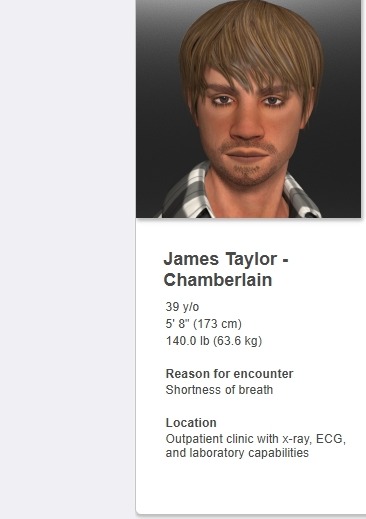
39 y/o
5′ 8″ (173 cm)
140.0 lb (63.6 kg)
Reason for encounter
Shortness of breath
James Taylor shortness of breath 39 year old ihuman history questions
- How can I help you today?
- Do you have any other symptoms or concerns we should discuss?
- Have you been having fevers?
- Do you have night sweats?
- Do you wheeze?
- Are you short of breath?
- When did you first notice feeling short of breath?
- How long does your shortness of breath last?
- What are the events surrounding the start of your shortness of breath?
- Does your shortness of breath come and go?
- Does anything make your shortness of breath better or worse?
- Are you short of breath when lying down?
- Are you short of breath at rest?
- How severe is your shortness of breath?
- Do you awaken at night short of breath?
- What treatments have you tried for your shortness of breath?
- Are you………
James Taylor shortness of breath 39 year old ihuman physical exams required
- Weight
- Height
- cognitive status
- SpO2
- temperature
- blood pressure
- pulse
- respiration
- temperature
- auscultate heart
- auscultate lungs
- assess …….
Mastering the James Taylor iHuman Case Study: Navigating Shortness of Breath
Clinical simulation platforms challenge nursing and medical students to bridge the gap between textbook theory and real-world patient care. Among the most critical scenarios in virtual clinical education is the James Taylor iHuman case study. Presenting with a primary complaint of shortness of breath, this simulation tests a learner’s ability to perform a targeted clinical workup, synthesize complex patient histories, and formulate an evidence-based care strategy under pressure.
For students aiming to achieve top rubric scores without falling into common diagnostic traps, understanding the structural flow of this simulation is essential. Whether you are preparing to launch the module or reviewing your clinical reasoning skills, this overview breaks down the core components of the James Taylor scenario and shows how expert guidance from iHuman Tutor can streamline your academic success.
Case Overview: James Taylor Presenting with Shortness of Breath
In the virtual clinic, learners encounter James Taylor, a 39-year-old male who arrives seeking evaluation for progressive shortness of breath. Unlike straightforward respiratory cases involving acute trauma or simple seasonal allergies, this encounter requires students to look beyond surface-level complaints.
From the initial visual observations, the patient appears uncomfortable and exhibits increased work of breathing. To succeed in this iHuman simulation, students must recognize that dyspnea is a broad symptom with pulmonary, cardiovascular, infectious, and systemic etiologies. Rushing through the encounter or relying on generic respiratory templates will lead to missed clinical cues and lower evaluation metrics. If you find yourself stuck on complex virtual simulations, exploring comprehensive iHuman James Taylor shortness of breath answers can provide the clarity needed to master clinical workflows.
Strategic History Questions to Uncover the Clinical Picture
The foundation of every high-scoring simulation lies in asking the right history questions. Because iHuman grades learners on both thoroughness and efficiency, asking irrelevant questions can penalize your clinical efficiency score, while omitting critical inquiries leaves major gaps in your assessment.
When interviewing James Taylor about his shortness of breath, your questioning strategy should systematically explore:
Symptom Characterization (OLDCARTS): Clarifying the exact onset, duration, progression, and aggravating or relieving factors of his breathing difficulty.
Associated Constitutional Symptoms: Screening for systemic red flags such as fevers, night sweats, unexplained fatigue, or recent weight fluctuations.
Past Medical History and Adherence: Uncovering chronic health conditions, prior therapies, and potential gaps in long-term medical management.
Social and Lifestyle Factors: Evaluating occupational exposures, substance use, tobacco history, and personal risk factors that influence immune and respiratory health.
Mastering the art of targeted patient interviewing takes practice. Students looking to sharpen their clinical inquiry techniques can access structured nursing simulation tutoring to learn how to ask high-yield questions every time.
Conducting a Focused Physical Examination
Once the subjective interview is complete, transitioning to the physical examination requires precision. In the James Taylor iHuman scenario, visual and auditory cues immediately signal respiratory compromise, making a thorough cardiopulmonary and systemic exam non-negotiable.
Learners must carefully select examination maneuvers that confirm or rule out life-threatening causes of dyspnea. Key areas of focus include:
Vital Signs and Oxygenation: Assessing baseline hemodynamic stability, respiratory rate, heart rate, temperature, and pulse oximetry to gauge the severity of respiratory distress.
Comprehensive Chest and Lung Assessment: Performing systematic inspection, palpation, percussion, and auscultation across anterior and posterior lung fields to evaluate air movement and parenchymal integrity.
Cardiovascular and Lymphatic Evaluation: Checking heart sounds, peripheral perfusion, and regional lymph nodes to differentiate cardiac dysfunction from infectious or systemic processes.
Skipping critical maneuvers—such as chest percussion or targeted lymph node palpation—frequently results in lost points during the grading phase. Reviewing a structured physical examination checklist ensures no essential step is overlooked.
Narrowing Down the Differential Diagnosis
Synthesizing subjective interview data with objective physical findings leads directly to formulating an accurate differential diagnosis. In this case, students must weigh multiple competing hypotheses that explain subacute, progressive dyspnea accompanied by systemic symptoms.
A strong clinical reasoning process involves ranking potential conditions from most likely to least likely based on patient risk factors and exam findings. Learners should consider a broad spectrum of possibilities, including acute and subacute pulmonary infections, opportunistic pathogens, reactive airway diseases, cardiovascular etiologies, and systemic inflammatory conditions. Selecting the exact primary diagnosis requires connecting subtle clues from the patient’s medical background with objective respiratory findings.
Diagnostic Workup and Evidence-Based Management Plan
After establishing a prioritized differential list, the simulation evaluates your ability to order appropriate diagnostic tests without over-ordering unnecessary procedures. Selecting targeted laboratory panels, microbiological studies, and thoracic imaging is vital to confirming the underlying etiology safely and cost-effectively.
Finally, building a comprehensive management plan separates average performance from clinical excellence. A complete EHR submission for James Taylor must address:
Targeted Pharmacotherapy: Prescribing appropriate first-line antimicrobial and adjunctive therapies with exact dosing, routes, and durations.
Specialist Referrals and Consultations: Coordinating multidisciplinary care to manage both acute respiratory needs and long-term underlying health conditions.
Patient Education and Red-Flag Precautions: Delivering clear, empathetic counseling on medication adherence, disease management, and warning signs that require emergency intervention.
Get Complete Answers and Guidance for Your iHuman Case
Navigating the nuances of the James Taylor iHuman case study demands strong clinical judgment, precise documentation, and adherence to strict grading rubrics. Because this overview intentionally avoids giving away exact interview scripts, diagnostic test results, or definitive final answers, you may still want a complete walkthrough to verify your work before submitting your assignment.
Do not leave your clinical grades to chance. Visit iHuman Tutor today or place an order through our custom assignment help page to receive the complete, step-by-step case guide—including exact history questions, physical exam findings, confirmed diagnostic results, and a full APA-formatted management plan tailored to help you excel.