


31 August 2026
No Comments
iHuman assignment
iHuman Heather Stanton fatigue and irritability answers
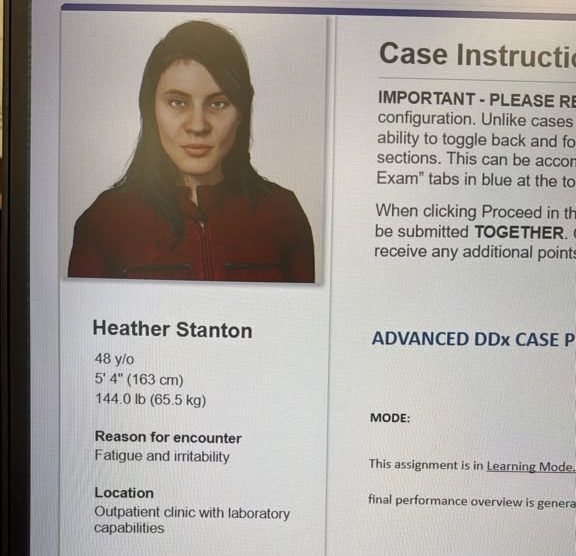
Heather Stanton
48 y/o
5′ 4″ (163 cm)
144.0 lb (65.5 kg)
Reason for encounter: Fatigue and irritability
iHuman Stefanie Newman shortness of breath History Questions
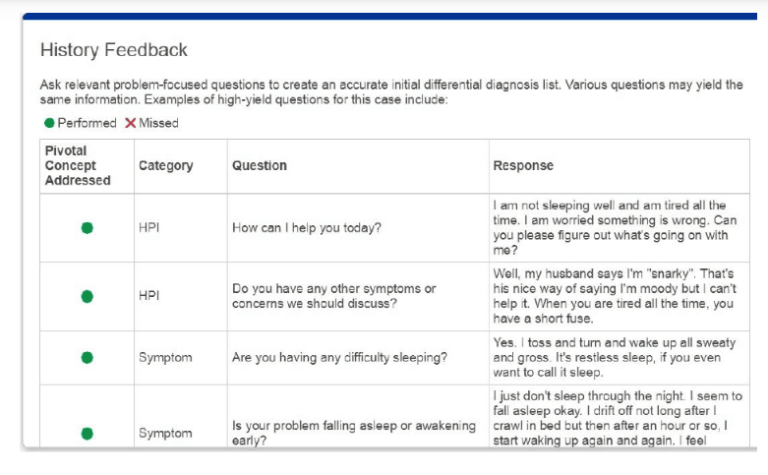
- How can I help you today?
- Do you have any other symptoms or concerns we should discuss?
- Are you having any difficulty sleeping?
- Is your problem falling asleep or awakening early?
- If you wake up in the middle of the night, are you able to fall asleep again?
- How often and at what times do you wake up at night?
- Does your fatigue/tiredness improve after a good night’s rest?
- Can you describe a typical night’s sleep?
- On average, how many hours per night do you sleep?
- How does the night’s sleep affect your day?
- …..
iHuman Heather Stanton fatigue and irritability answers
Physical Exams Required
- Weight
- Height
- cognitive status
- SpO2
- temperature
- blood pressure
- pulse
- respiration
- temperature
- auscultate heart
- auscultate lungs
- assess …….
iHuman Case Study Walkthrough: Heather Stanton, 48, Fatigue and Irritability
Nursing students working through the iHuman simulation platform regularly encounter cases that test far more than textbook recall — they demand a structured clinical reasoning process under realistic time pressure. One case that consistently trips up NP and DNP students is Heather Stanton, a 48-year-old woman presenting with fatigue and irritability. If you’ve been assigned this case and are searching for guidance on how to approach it, this overview breaks down the clinical reasoning framework without giving away the specific answers your instructor expects you to work through independently.
Why the Heather Stanton Case Is Deceptively Difficult
At first glance, “fatigue and irritability” sounds like a vague, catch-all chief complaint. That’s exactly what makes this iHuman case a favorite among faculty designing assessments for advanced practice students. The presentation sits at the intersection of several overlapping symptom clusters, and a 48-year-old female patient means students have to hold multiple differential diagnosis categories in mind simultaneously rather than anchoring too quickly on one system.
Students often report that the hardest part isn’t identifying a single condition — it’s resisting premature closure. Fatigue and irritability in a middle-aged woman can point toward endocrine changes, mood-related etiologies, sleep disruption, thyroid dysfunction, or a combination of overlapping processes. Getting the case right means asking history questions that are broad enough to rule things out, then narrowing with precision once the pattern becomes clear.
The Skill Being Tested: History-Taking, Not Guessing
iHuman cases are built to reward methodical history-taking over pattern-matching shortcuts. For a case like Heather Stanton’s, the platform is scoring how efficiently and completely a student gathers subjective data before jumping to conclusions. This includes:
- Onset, duration, and progression of fatigue
- Associated symptoms that the patient may not volunteer unprompted
- Sleep quality and nighttime symptom patterns
- Mood and behavioral changes noticed by the patient or family
- Menstrual and reproductive history, given the patient’s age
- Relevant social, family, and medication history
Missing even one pivotal question can silently tank a student’s history-taking score, even if the final diagnosis ends up correct. This is one of the most common reasons students underperform on iHuman cases despite understanding the underlying pathophysiology.
Physical Examination: Where Precision Matters
Once the history phase closes, the physical examination component of the Heather Stanton case requires targeted, system-specific assessment rather than a generic head-to-toe exam. iHuman grades physical exam performance based on relevance — performing unnecessary maneuvers can cost points just as much as skipping pivotal ones. For a 48-year-old woman with fatigue and irritability, examiners are looking for whether students correctly prioritize vital signs, targeted system exams, and any findings that either support or rule out the leading differential diagnoses.
Students frequently underestimate how much the physical exam step contributes to the overall case score, treating it as a formality after the history. In reality, it’s where many of the “pivotal concept” checkpoints live.
Building the Differential Diagnosis List
This is the stage where the case truly separates strong clinical reasoning from guesswork. A well-constructed differential for a patient like Heather Stanton should reflect the full range of plausible explanations for her presenting symptoms, appropriately ranked by likelihood and by which “must not miss” conditions need to be excluded first. Students are expected to justify their reasoning, not just list conditions.
Because this case centers on a demographic and symptom pattern with several overlapping possibilities, instructors use it specifically to see whether students can differentiate between conditions with similar presentations rather than jumping to the most commonly discussed diagnosis in lecture.
From Diagnosis to Management Plan
The final and often most heavily weighted portion of the case is the management plan. iHuman expects a comprehensive, evidence-based plan that mirrors real EHR documentation standards: diagnostic testing with rationale, medication decisions written as full prescriptions, referrals where appropriate, patient education points, and a clearly defined follow-up interval with red-flag return criteria. For a case involving fatigue, irritability, and the clinical picture surrounding a 48-year-old patient, the management plan also needs to reflect current clinical guidelines and cite legitimate, peer-reviewed sources — not generic textbook statements.
This is where many students lose the most points, simply because building a complete, correctly formatted, well-cited plan from scratch under time pressure is genuinely difficult, even when the diagnosis itself was correct.
Where Students Get Stuck
Based on patterns across iHuman coursework, students working through the Heather Stanton case typically struggle with:
- Structuring history questions efficiently instead of asking everything
- Recognizing which physical exam findings are actually pivotal
- Avoiding premature or overly narrow differential diagnosis lists
- Writing a complete, guideline-based management plan under a time limit
- Formatting EHR documentation to match academic rubric expectations
Get Comprehensive, Fully Worked Answers
If you’re working through the Heather Stanton case — or any other iHuman simulation — and want a complete walkthrough covering pivotal history questions, physical exam priorities, a fully reasoned differential diagnosis, and a guideline-based management plan formatted to EHR documentation standards, comprehensive case support is available at iHumantutor.com.
iHumantutor.com specializes in helping nursing and NP students work through iHuman cases with properly cited, submission-ready documentation that reflects current evidence-based practice. Rather than guessing your way through pivotal concepts or risking incomplete history-taking, you can order a complete, verified answer set built specifically for cases like this one.
Visit iHumantutor.com to get your comprehensive case answers today.