


10 June 2026
No Comments
iHuman assignment
iHuman Brianna Gill pain when I pee 28 year old answers
iHuman Brianna Gill pain when I pee 28 year old answers
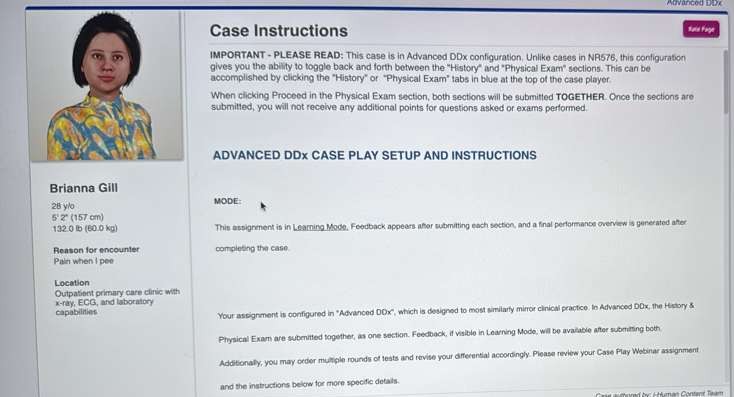
Reason for encounter Pain when I pee
28 y/o
5′ 2″ (157 cm)
132.0 lb. (60.0 kg)
Location
Outpatient clinic with x-ray, ECG, and laboratory capabilities
iHuman Brianna Gill pain when I pee answers History Questions
- How can I help you today?
- Do you have any other symptoms or concerns we should discuss?
- Do you have pain/discomfort when you urinate?
- When did your pain/discomfort with urination start?
- What are the events surrounding the start of your pain/discomfort with urination?
- Does anything make your pain/discomfort with urination better or worse?
- How severe is your pain/discomfort with urination?
- Does your pain/discomfort with urination come and go?
- Have you passed any stones in your urine?
- How long does your urination pain/discomfort last?
- What treatments have you….
iHuman Brianna Gill pain when I pee answers NR602
Physical Exams
- Weight
- Height
- cognitive status
- SpO2
- temperature
- blood pressure
- pulse
- respiration
- temperature
- auscultate heart
- auscultate lungs
- assess …….
Master iHuman Brianna Gill pain when I pee 28 year old answers
Are you tackling the popular iHuman Brianna Gill case study and trying to navigate the complex clinical presentation of a 28 year old female complaining of a burning sensation during urination? Understanding how to approach this patient encounter—from selecting the right history questions to executing an accurate physical examination—is essential for earning top marks on your virtual patient simulator.
This comprehensive case study breakdown guides you through the necessary workup plan, clinical documentation steps, and differential diagnosis mapping needed to master this simulation. For more step-by-step walk-throughs of advanced nursing simulations, check out the ultimate resource for nursing students at iHumanTutor.com.
Patient Overview: Brianna Gill, 28-Year-Old Female
When you first open the simulation, you are introduced to B.G., a 28 year old female presenting with an acute genitourinary complaint.
Age: 28
Height: 5′ 2″ (157 cm)
Weight: 132.0 lbs (60.0 kg)
Chief Complaint: The patient states, “I have pain when I pee and I’ve also noticed some unusual vaginal discharge.”
To successfully clear the initial gating screens, you must look past the superficial symptoms. While a patient saying “it hurts when I urinate” often points toward a routine urinary tract infection (UTI), the co-occurrence of vaginal tracking symptoms requires a much broader clinical lens.
Step 1: Expert IHuman Brianna Gill pain when I pee 28 year old History Questions
The history-taking segment is where many students lose critical points by asking irrelevant or redundant questions. For Brianna Gill, your subjective interview must systematically evaluate her urinary tract, reproductive tract, sexual behaviors, and systemic signs.
To secure the highest score on your clinical literacy metrics, ensure your history questions cover the classic OLDCARTS parameters:
Symptom Character & Timing: Determine the exact color, odor, and consistency of the discharge, and whether the dysuria occurs throughout micturition.
Associated Genitourinary Symptoms: Inquire about urinary frequency, urgency, hematuria, or postcoital spotting.
Sexual Health History: Document the number of active partners over the past 6 months, barrier contraceptive habits, contraceptive adherence, and the timeline of her last STI screening.
Systemic Exclusions: Ask targeted questions regarding the presence of fevers, chills, nausea, vomiting, or flank discomfort to evaluate for ascending infections.
If you are looking for the exact questionnaire sequence and verified expert student responses, access the complete iHuman Brianna Gill Pain When I Pee 28-Year-Old Case Guide for immediate assistance.
Step 2: Targeted Physical Examination
Once the subjective interview is complete, your physical examination must be structured, deliberate, and detailed. In an advanced electronic health record (EHR), general statements like “normal” or “WNL (within normal limits)” are avoided in favor of measurable, objective terminology.
[Systemic Evaluation] ➔ [Abdominal Palpation] ➔ [Pelvic Speculum/Bimanual Exam]
      (Rule out Fever)          (Assess Tenderness)          (Identify Local Pathology)
Your objective clinical workup plan should focus heavily on these key systems:
Vitals: Assess for the presence of a fever or hemodynamic instability.
Abdomen: Perform deep palpation across all four quadrants, specifically checking for suprapubic tenderness or rebound tenderness. Conduct fist percussion at the costovertebral angles (CVA).
Lymphatic: Palpate the horizontal and vertical chains of the inguinal lymph nodes to evaluate for localized adenopathy.
Genitourinary/Pelvic: Perform a thorough external inspection, followed by a speculum exam to view the vaginal vault and external cervical os. Complete the assessment with a bimanual pelvic exam to check for internal reproductive tract tenderness or masses.
Step 3: Developing the Differential Diagnosis
A brilliant management plan relies entirely on a solid diagnostic framework. Based on the history and exam findings, you must organize your differential diagnosis from the most probable to the least probable conditions.
Consider the following clinical directions during your simulation workup:
Acute Pathogenic Cervicitis: Indicated by localized cervical inflammation, structural tissue friability, and purulent tracking discharge.
Acute Infectious Urethritis: Supported by the prominent symptoms of dysuria, urgency, and increased urinary voiding frequency.
Acute Bacterial Cystitis (UTI): A strong standard differential for urinary complaints, though less likely to fully explain concurrent cervical friability or thick yellow vaginal secretions.
Vaginal Dysbiosis (BV or Trichomoniasis): Must remain on your active differential list until ruled out by point-of-care wet mounts or vaginal microscopy.
Step 4: Diagnostic Workup Plan
To narrow down your differentials and finalize your plan of care, select a comprehensive suite of diagnostic tests within the simulator. Your diagnostic plan should include:
Gold-Standard NAAT Screening: Endocervical or vaginal swabs using Nucleic Acid Amplification Testing to screen for common bacterial pathogens.
Microscopy & Wet Mount: To visually evaluate vaginal fluid for clue cells, trichomonads, or hyphae.
Urinalysis with Reflex Culture: To screen for leukocytes, nitrites, and underlying coliform bacteria.
Serum STI Panel: Comprehensive screening for systemic blood-borne exposures.
By understanding the underlying pathophysiology of these overlapping conditions, you can accurately build your differentials, ace your simulation, and develop an exemplary care plan. For premium access to comprehensive study materials, clinical templates, and expert-vetted answers for your assignments, navigate to iHumanTutor.com today!