


10 June 2026
No Comments
iHuman assignment
iHuman Brianna Gill pain when I pee 28 year old answers
iHuman Brianna Gill pain when I pee 28 year old answers
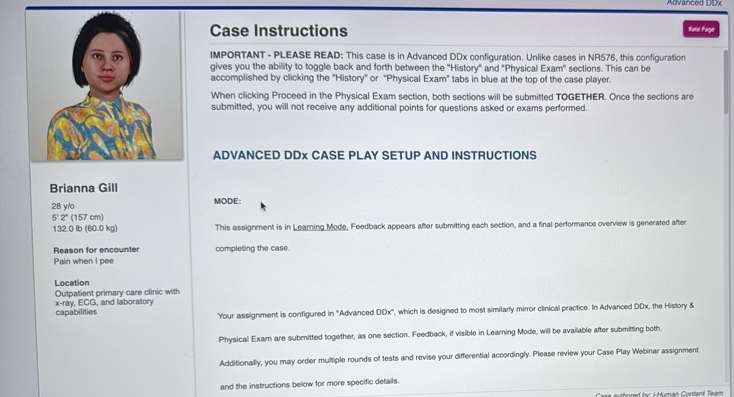
Patient Demographic & Clinical Setting
Patient Name: Brianna Gill
Age & Gender: 28-Year-Old Female
Height & Weight: 5′ 2″ (157 cm) | 132.0 lbs (60.0 kg)
Chief Complaint (CC): “Pain when I pee”
Encounter Location: Outpatient Primary Care / Urgent Care Clinic (with laboratory, dipstick urinalysis, and X-ray capabilities)
iHuman Brianna Gill pain when I pee answers History Questions
- How can I help you today?
- Do you have any other symptoms or concerns we should discuss?
- Do you have pain/discomfort when you urinate?
- When did your pain/discomfort with urination start?
- What are the events surrounding the start of your pain/discomfort with urination?
- Does anything make your pain/discomfort with urination better or worse?
- How severe is your pain/discomfort with urination?
- Does your pain/discomfort with urination come and go?
- Have you passed any stones in your urine?
- How long does your urination pain/discomfort last?
- What treatments have you….
iHuman Brianna Gill pain when I pee answers NR602
Physical Exams
- Weight
- Height
- cognitive status
- SpO2
- temperature
- blood pressure
- pulse
- respiration
- temperature
- auscultate heart
- auscultate lungs
- assess …….
iHuman Brianna Gill: 28-Year-Old Female with Dysuria (Pain When I Pee) Case Study Answers
1. Focused Health History Questions
To achieve a high history score on this iHuman case, ask the following targeted questions to differentiate uncomplicated lower urinary tract infection (acute cystitis) from pyelonephritis, vaginitis, or sexually transmitted infections (STIs):
How can I help you today?
Patient Response: “I have a burning pain whenever I pass urine.”
When did your pain or discomfort with urination start?
Purpose: Establishes acute vs. chronic onset (typically 2–4 days duration).
How severe is your pain on a scale of 1 to 10?
Purpose: Quantifies dysuria severity.
Do you have to urinate more frequently than usual, or feel a sudden strong urge to go?
Purpose: Assesses classic lower urinary tract symptoms (frequency and urgency).
Have you noticed any changes in the color or odor of your urine, or seen blood in your urine?
Purpose: Checks for hematuria, cloudiness, or malodorous urine indicative of acute bacterial cystitis.
Do you have any flank pain, back pain, fever, chills, nausea, or vomiting?
Purpose: Critical red-flag screening to rule out acute pyelonephritis (upper UTI).
Are you experiencing any abnormal vaginal discharge, vaginal itching, or pelvic pain?
Purpose: Distinguishes urethritis/cystitis from vulvovaginal candidiasis, bacterial vaginosis, or trichomoniasis.
Are you currently sexually active, and do you use barrier protection or new personal hygiene products?
Purpose: Identifies behavioral risk factors and non-infectious irritants (e.g., contact dermatitis).
Have you had similar urinary symptoms or urinary tract infections in the past?
Purpose: Evaluates for recurrent UTIs.
Do you have any chronic medical conditions, such as diabetes mellitus or kidney stones?
Purpose: Rules out complicated UTI risk factors.
2. Essential Physical Examination Steps
Perform the following targeted physical exam maneuvers to confirm local clinical signs and rule out systemic involvement:
Vital Signs: Assess temperature (rule out fever), heart rate, blood pressure, respiratory rate, and SpO2.
General Appearance: Observe level of distress, comfort, and alertness.
Abdominal Examination:
Inspection of abdomen for distension.
Auscultation of bowel sounds across all four quadrants.
Palpation: Light and deep palpation for suprapubic tenderness (typical in acute cystitis) and guarding.
Costovertebral Angle (CVA) Tenderness: Perform direct percussion over the bilateral CVA (Kidney Punch Test) to evaluate for pyelonephritis (expected negative for uncomplicated cystitis).
Pelvic Examination (if indicated): Inspect for external lesions, cervical motion tenderness, or abnormal vaginal discharge to exclude PID/STI.
3. Diagnostic Reasoning & Differential Diagnoses
Primary Diagnosis
Acute Uncomplicated Cystitis (ICD-10: N30.00)
Clinical Rationale: Classic triad of acute dysuria, urinary frequency, and suprapubic discomfort in a young, non-pregnant female without systemic signs (fever, CVA tenderness, or flank pain). Most common causative organism is Escherichia coli.
Differential Diagnoses
Acute Urethritis (STI-related: Chlamydia trachomatis / Neisseria gonorrhoeae)
Distinguishing Features: Gradual onset, internal dysuria, lack of suprapubic pain, potential mucopurulent vaginal discharge.
Vulvovaginitis (Candidiasis / Bacterial Vaginosis)
Distinguishing Features: External dysuria (burning as urine hits irritated vulvar skin), vaginal itching, discharge, absence of urinary frequency.
Acute Pyelonephritis (ICD-10: N10)
Distinguishing Features: Upper tract infection characterized by fever, rigors, flank pain, nausea, and positive CVA tenderness on examination.
4. Laboratory Findings & Diagnostic Workup
Dipstick Urinalysis (In-Office):
Leukocyte Esterase: Positive (indicative of pyuria).
Nitrites: Positive (indicative of Enterobacteriaceae such as E. coli).
Microscopic UA: >10 WBCs/HPF>10\text{ WBCs/HPF}>10 WBCs/HPF, presence of bacteria, trace RBCs (microscopic hematuria).
Urine Culture & Susceptibility: Indicated if symptoms are atypical, recurrent, or if local resistance patterns dictate.
STI Nucleic Acid Amplification Test (NAAT): Urine or cervical swab for C. trachomatis and N. gonorrhoeae if sexually active with new/multiple partners.
5. Management & Treatment Plan
Pharmacotherapy (First-Line Empirical Therapy)
Nitrofurantoin Monohydrate/Macrocrystals (Macrobid): 100 mg100\text{ mg}100 mg PO BID for 5 days.
Alternative: Trimethoprim-Sulfamethoxazole (TMP-SMX DS): 160/800 mg160/800\text{ mg}160/800 mg PO BID for 3 days (if local resistance <20%<20\%<20%).
Alternative: Fosfomycin Trometamol: 3 g3\text{ g}3 g PO single dose.
Symptomatic Relief: Phenazopyridine (Pyridium): 200 mg200\text{ mg}200 mg PO TID PRN for 1–2 days for dysuria relief (advise patient on transient orange-red urine discoloration).
Patient Education & Counseling
Hydration: Maintain generous fluid intake (2–3 L2\text{–}3\text{ L}2–3 L daily) to promote urinary flushing.
Hygiene Practices: Wipe front-to-back following bowel movements; void promptly after sexual intercourse.
Red-Flag Warnings: Instruct patient to seek immediate medical re-evaluation if fever, severe flank/back pain, nausea, vomiting, or persistent symptoms develop after completing antibiotics.